
“Being a land artist sometimes feels a little like being part flower arranger, part craftsman, part gardener and part labourer. It’s like making and solving a jigsaw puzzle.” (Winston Plowes 2023)
Artists have been fascinated by apples for centuries, using them as symbols while also experimenting with their form and colours. Today, this playfulness continues. The art of the apple is not confined to the fruit bowl. In this series of posts I will be writing about modern artists who have taken a big bite out of the artistic apple.

Winston Plowes is a poet and land artist. He is based near Hebden Bridge, Yorkshire, England. Winston and I met online a few years ago through poetry activities, via some mutual friends. I have been following his journey from found and spontaneous poetry, across into environmental art, with great interest. His work with apples has made me consider how our few remaining ‘wild’ apple trees and traditional orchards sit within the landscape, often in the less productive and overlooked edges of the land. Winston and I recently had this conversation by email. I am J, he is W.
J) Winston, thank you for taking the time to answer my questions. In your recent work you use everyday organic materials such as white bread, dog treats, and apples in a playful way, while showing the beauty in their form. Land art is often very site specific but some of your pieces would work wherever people can appreciate them. Do you choose the site first or the materials?
A) Using manmade edible materials is a recent twist for me and the work with dog treats was for a commission to make something for the floor of two art galleries where the art and poetry on display was all dog based. I liked the idea that I was making something to be played with and devoured by our canine companions. It was a pleasant change from the anxiety dogs can cause when they interact with my work. Sometimes I will stumble across leaf stalks that are turning from yellow to red, a particular texture of clay or pebbles with a unique shape or pattern and I just collect these and squirrel them away for another day. The work with apples has sort of crept up on me. In one way it’s no different to using nature’s other resources like seeds and berries but when I’ve used tools like an apple corer or knife to make cubes and discs from the apple flesh things have felt rather different. Apples are truly beautiful things to work with and I’m sure there’s more scope there.
J) So do you find yourself drawn to a particular type of location?
W) Being a land artist makes you look at things differently, whether it’s a beach, stream or woodland path, every slab of stone or tree trunk is a potential location for a piece of art, and I like it when the materials are close to the location as that feels more natural. Living roughly in the middle of the country in beautiful Calderdale always makes a pilgrimage to the coast a special treat and I’m lucky to be able to do that regularly. It was on one such trip to Scarborough when I stayed in a Shepheard’s hut within an orchard with hundreds of apples just waiting to be made into art. One of the most magical and memorable locations ever and where I fell in love with the Bramley!
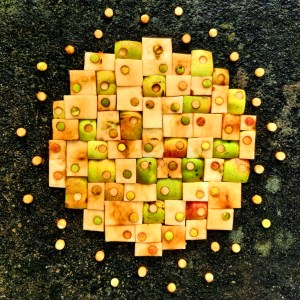
J) How big are the apple works? I can’t quite get the scale of them from your lovely photos. Do you think that a certain size seemed ‘right’ or did you carry on until you ran out of apples?
W) Scale is an interesting aspect of my work. Sometimes the size of a piece is governed by how many leaves, stones or shells are available. On another day, it’s simply time or the weather or how much light’s left in the day that stops play. Sometimes a piece will take many hours to complete, or it might be the simple act of balancing one stone on another that’s enough. The piece Core, for example is about three feet across, just a little less than the paving slab on which it stands.

J) I enjoy the way in which wildlife – slugs and birds – became part of the pieces, changing things and re-arranging the work. Was this something you thought would happen or was it an accidental benefit. Could you see any other artist/animal collaborations in future?
W) This happens often and never more magically than when a robin landed in the middle of a ring of sycamore stalks I was working with and did a little dance. This performance followed a worm making its way across the piece, slowly dislodging each stalk as it went. It made me feel that I was a guest making something in these creatures’ worlds. All this reminds me that, unlike more traditional ways of making art, like painting, by being an environmental artist you open yourself more to ‘the experience’ of making something. And you might remember those unique experiences even more than how the finished piece looked. I am currently wondering what ‘art for birds’ might look like and how it will be interacted with.
J) Wow. I can’t wait to see some ‘art for birds’. Robins and blackbirds love apples, and they certainly leave their mark on the windfall fruits in the orchard. Personally I find that environmental art brings forward the ideas of change, decay, circles of decomposition and regrowth. I know that every viewer will have their own reaction to your art, but what do you hope that viewers of your work will feel?
W) Some people who see my work think it’s pretty or appreciate the effort involved and that’s nice, but as you say, there is often a much deeper message to explore. Like us, all trees are at the same time different and the same. Within nature there are so many lessons to learn about patience, resilience and hope. It sometimes amazes me just how many analogies exist. There’s a lesson to be learned too when the elements conspire to disrupt a work in progress. Can we come to terms with this and accept something we can’t control? The artist Andy Goldsworthy once said, “we can’t possess anything in nature” and I like that.
J) You mentioned in your commentary on making the Halo installation from bread, that working on it was like a meditation. Do you think that the ‘ordinary’ person, someone who does not label themselves as an artist, can get benefit from arranging organic objects into patterns?
W) Making Halo from over a thousand white bread strips for three hours a day over three days was such a feat of physical endurance and mental focus that the only way to complete it was to treat it as a meditation. During this process many ‘ordinary’ people visited the gallery and said extraordinary things I hadn’t even thought of. This art was a peace offering with a positive, unifying and uniting message for a world which so often seems at odds with itself. One person saw hundreds of crosses, each made from two bread soldiers, echoes of loss on the battlefield. Another saw an unblinking eye or a circle of life. It’s interesting that you mention patterns and that’s in essence what we are dealing with here and whilst we can’t really outdo nature herself, we can join in with her games and as adults relearn how to play. In my work with mental health charities I’ve found both adults and young people are rewarded by the physical act of making patterns and the accompanying conversations around the process.
J) So you feel that working with patterns can change us and deepen our connections with our environment. Has it done the same for you?
W) I think being an artist has indeed changed me. It has helped me appreciate, connect with and understand the world around me so much. It can be absolutely enough to become totally absorbed in a world that’s only two feet across. As land artists we are spokespersons and ambassadors for nature and our work can be a focus for the fragile miracle that is the living, breathing natural world.

J) I know that your poetry includes opportunities for found poems, accidental poems etc, and that made me think about the intersections between your two practices. How is the creative process different, or similar, from that of poetry? To me poetry is a more intellectual practice, even academic perhaps, whereas environmental art allows consideration of texture, form, smell, even. We discussed how different apples would contribute a different scent to a piece, while they decayed. But the process of arranging the items (the words) into a pleasing pattern is similar, perhaps?
W) The more I am asked to devise activities that involve both creative writing and environmental art, the more connections I discover between these two contemplative and reflective practices. At the heart of both are how we match natural resources or words together and make patterns. The patterns of sound made by rhyme, repetition and alliteration are what makes a collection of words into a poem. Maybe because I work in primary schools, I don’t see poetry as intellectual or academic, instead I see it as something playful, surprising and accessible. Both poetry and art are for everyone.
J) I find your work has resonances with many styles of art, for me these include stained glass windows, mediaeval pattern books, William Morris wallpaper. Are you inspired by artists other than land artists?
W) I am indeed. The Op Art of Bridget Riley continues to be a huge influence on both my poetry and art, Piet Mondrian and Andy Warhol also. Alongside this, the work of other land artists from the ‘liability’ (the self-coined collective noun for land artists) is of course, a huge guiding influence and there is little room for ego amongst a community of artists working with such ephemeral and transient resources. Being a land artist sometimes feels a little like being part flower arranger, part craftsman, part gardener and part labourer. It’s like making and solving a jigsaw puzzle.
J) Thar’s a great description. So, now for the apple-related questions. What is your favourite apple, and your favourite apple dish?
W) I like a good russet though don’t seem to see them anymore. Two years ago I was really drawn to the romantic food writing of Nigel Slater whose recipe for pickled quince reads like a love poem to the fruit. In days I went from not knowing what a quince was, to pickling jars and jars of them and now I have made art from them for the first time especially for you!
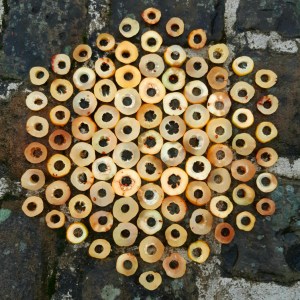

on 29 December 2023.
J) Thank you for that gift! The quince, cydonia oblonga, is a hard fruit that is related to both apples and pears. The scent of the fruit is amazing, but you have to cook it a lot before you can eat it. I’ve seen quinces depicted in those wonderful seventeenth century Dutch still life paintings, and Vincent Van Gogh painted a heap of them, but your piece, Hive, may well be a unique use of quince in environmental art. I like the way the colours and textures are deepening and ripening as it slowly decays.
J) You mentioned camping in an orchard, but have you ever grown an apple tree?
W) I’m not good at growing things but count trees amongst my friends. There’s one particular hollow oak tree that I talk to regularly and you know what? It never interrupts or answers back. It’s the best listener I know. I will be returning to the orchard in Scarborough in the autumn as well as other favourite locations and when I make art there, I will do so in absolute sympathy with the location. I will only use things that I find on the ground. I like the idea that inside every apple is a hidden star (if you cut one in half you will find one too) so would like to maybe feature that or use apple peel in my art somehow.
 Apple Histories